

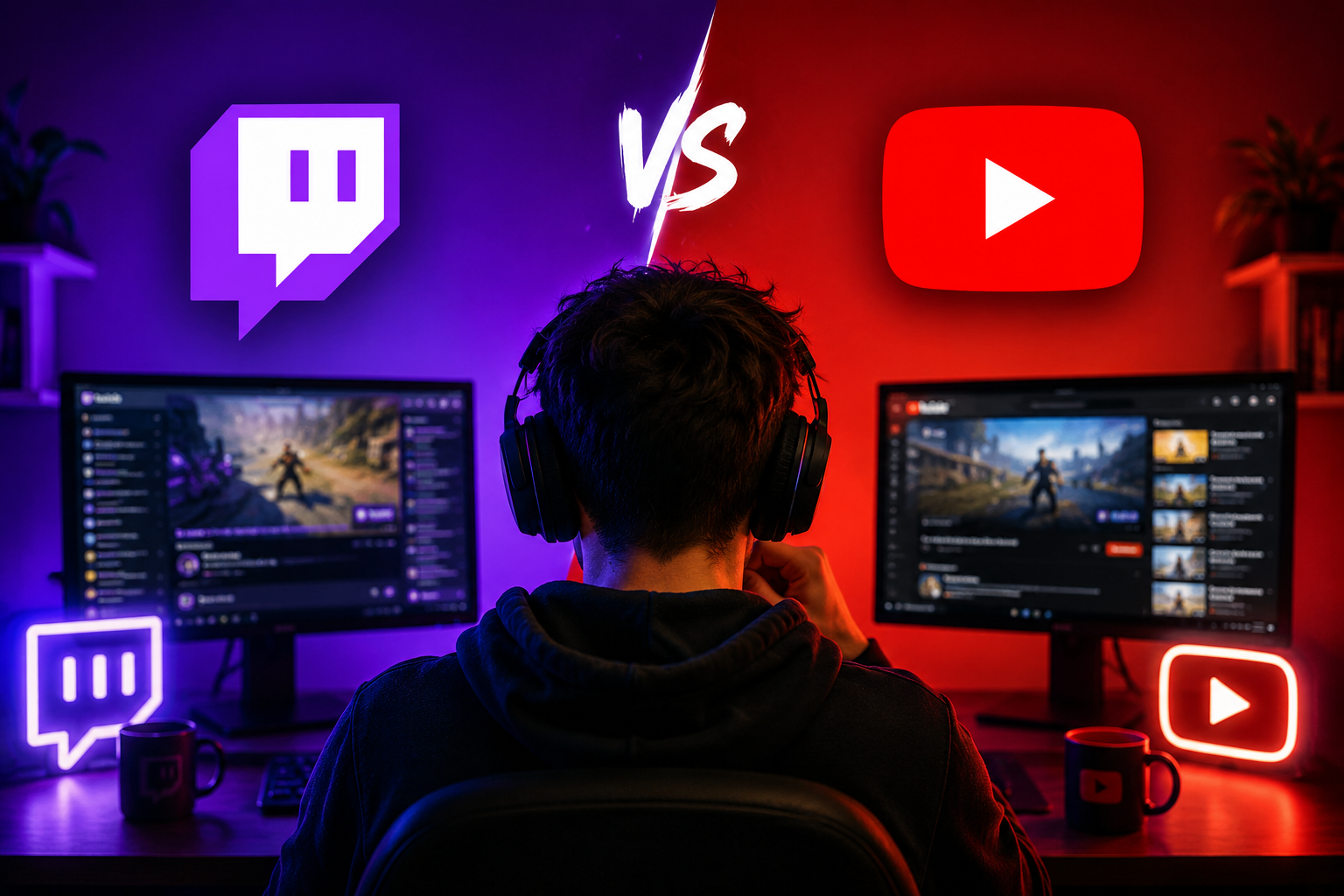

So you’ve set up your stream, you’ve got your mic, maybe even tested your lighting and now you’re staring at two browser tabs: Twitch and YouTube. Both are massive. Both have made real people into real careers. And both will make you feel, at some point, like you’re shouting into a void.
The question of Twitch or YouTube has no single right answer. But it does have a right answer for you and that’s exactly what this post is going to help you figure out. Let’s get into it.
What Even Is the Core Difference Between Twitch and YouTube?
Before you stress over monetization thresholds or subscriber counts, it helps to understand the soul of each platform.
Twitch was built for live moments. It launched in 2011 as a gaming platform, and that DNA is still very much alive. Today, Twitch has over 240 million monthly users, and it holds roughly 54% of the live gaming streaming market. When you go live on Twitch, you’re entering a space where people have come specifically to watch something happen in real time. The chat is chaotic. The emotes are weird. The community energy is unmatched. And when your stream ends? So does most of your traction.
YouTube, on the other hand, is a hybrid universe. Yes, you can go live. But you can also upload edited videos, turn your stream highlights into Shorts, and let your content keep earning while you sleep. With over 2.49 billion monthly active users across all content types, YouTube isn’t just a streaming platform it’s the world’s second-largest search engine. That matters a lot, especially for growth.
Twitch Overview: Pros and Cons
Twitch has a culture you can feel the moment you start watching. It’s loud, loyal, and genuinely one of a kind.
What’s great about Twitch:
Discoverability is community-driven. If a bigger streamer “raids” your channel (sends their audience over after their stream ends), you can go from 2 viewers to 200 overnight. That kind of organic momentum doesn’t exist on YouTube. Twitch viewers are also culturally trained to financially support creators through subscriptions, Bits, and Prime Gaming benefits. The community aspect is Twitch’s biggest superpower.
Twitch also recently expanded monetization access. You no longer need Affiliate status to unlock Channel Points, Bits, and Emotes. That’s a meaningful change for brand-new streamers who want to build community engagement from day one.
Where Twitch falls short:
The moment you stop streaming, you’re essentially invisible. Twitch’s search and recommendation system heavily favors established channels. Studies show the top 0.1% of streamers dominate total watch time, which means breaking through as a newcomer is genuinely hard. There’s also no long-tail discovery someone can’t stumble upon your stream from a Google search three months after you went live.
YouTube Overview: Pros and Cons
YouTube is patient in a way Twitch isn’t. Your content keeps working for you long after you’ve logged off.
What’s great about YouTube:
YouTube’s algorithm recommends your videos to people who’ve never heard of you. A single well-titled stream or highlight clip can bring in thousands of views organically. YouTube also lets you repurpose content across multiple formats live stream one day, turn it into a VOD, clip it into a Short, and suddenly one session is generating revenue in three different ways.
On the monetization side, YouTube creators consistently report higher ad revenue. Major creators have noted that YouTube ad earnings can exceed Twitch earnings by 10x or more for the same content. Your RPM (revenue per mille) typically ranges from $1.50 to $4 depending on your niche and audience location.
Where YouTube falls short:
Getting into the YouTube Partner Program requires 1,000 subscribers and 4,000 hours of watch time (or 10 million Shorts views). That’s a slower climb compared to Twitch’s Affiliate program, which only requires 50 followers and 3 average concurrent viewers. YouTube’s live chat also feels less intimate than Twitch’s viewers aren’t as conditioned to subscribe or tip mid-stream.
Twitch vs YouTube: Content Format and Audience
Here’s something a lot of new streamers overlook: the type of content you make matters as much as the platform you choose.
Twitch leans heavily into gaming, though it has expanded into IRL (In Real Life) streams, music, art, and “Just Chatting.” If you’re a gamer who plans to stream 4+ hours daily and wants real-time conversation, Twitch fits that workflow beautifully.
YouTube has no single dominant niche. Tech reviews, DIY, cooking, fitness, finance it all lives there. If your content reaches beyond gaming, or if you want to build a searchable archive that grows over time, YouTube is the more flexible home.
Think about your target audience too. Twitch skews younger and male, with an especially strong eSports following. YouTube’s user base is broader, older on average, and more globally distributed.
Twitch vs YouTube: Who Pays More?
This is the question everyone actually wants answered, so let’s not dance around it.
Twitch Payout Model
Twitch pays through subscriptions (split 50/50 between Twitch and the creator for Affiliates, with Partners potentially earning up to 70%), Bits (virtual currency from viewers), ad revenue during streams, and brand deals. A Twitch stream with 75,000 concurrent viewers could generate upwards of $11,000 through ads and subscriptions in a single session. But that level of viewership isn’t easy to reach.
The income is audience-dependent and stops when the stream ends.
YouTube Payout Model
YouTube monetizes through pre-roll and mid-roll ads on both live streams and VODs, Super Chats, channel memberships, YouTube Premium revenue share, and Shorts bonuses. YouTube takes a 45% cut and passes the rest to creators. The key advantage is passive income your content keeps generating revenue long after you’ve stopped streaming.
Some creator partners report making up to 70% of their revenue from 24/7 YouTube streams. That’s content working around the clock.
Who Gets Paid More?
In the short term, Twitch is faster to initial monetization. In the long term, YouTube wins especially for mid-to-large channels in high-CPM niches. The smartest creators in 2026 aren’t choosing between the two. They’re doing both.
Twitch vs YouTube for New Streamers: Which Should You Start With?
Twitch Advantages for New Streamers
Getting to Affiliate on Twitch is genuinely achievable within weeks if you’re consistent. The community rallies around new creators in ways that YouTube’s algorithm simply doesn’t. Raids, host mode, and Discord integrations create a support ecosystem that feels human.
YouTube Advantages for New Streamers
If you’re patient and consistent, YouTube’s compounding algorithm is one of the most powerful growth machines available to a creator. Your stream from six months ago can still bring in new subscribers today. That’s something Twitch literally cannot offer.
If you’re trying to grow fast and thrive on live energy start on Twitch. If you’re building something for the long haul with multiple content formats start on YouTube.
Streaming Quality, Interface, and Tools
Both platforms support 1080p60fps streaming for most creators, and both have introduced 4K live streaming capabilities. The difference shows up in how they handle the experience.
Twitch’s interface is purpose-built for live content. The side panel, chat overlay, alerts, and Bits interactions are baked right in. It’s streamlined if live streaming is your only goal.
YouTube’s Studio interface is more complex because it does more. You manage live streams, VOD uploads, Shorts, playlists, and analytics all in one place. There’s a steeper learning curve, but the payoff is a more versatile content operation.
Content Moderation and Policies
Twitch has faced some criticism for inconsistent moderation, though it has improved over the years. YouTube is stricter and more algorithmic in enforcement, which can hurt channels in grey-area niches. Know the rules of whichever platform you choose before you build your audience there.
Benefits of Multi-Streaming (And Why Most Smart Creators Do It)
Here’s the thing you don’t have to choose.
Multi-streaming, or simulcasting, means broadcasting on Twitch and YouTube at the same time. Creators who’ve tried it have reported live viewership increases of 30% on Twitch while simultaneously gaining 20,000+ VOD views on YouTube from the same session. That’s the same effort, multiplied.
The challenges are real though. You’ll need to manage two chats simultaneously, which can feel overwhelming. Your engagement on each platform may also be shallower than if you focused on just one. And some platforms have rules: Twitch Partners are restricted from simulcasting on competing platforms during live streams, though Affiliates and non-partnered streamers are free to multistream.
With the right setup, the benefits far outweigh the challenges. Tools exist to route your stream to multiple platforms simultaneously without duplicating your workload.
If you want to learn how to grow your streaming presence strategically including how to run smart ad campaigns that actually reach your audience the team at NexTech Ads specializes in digital advertising for creators and brands. Worth bookmarking.
Twitch vs YouTube: An Expert’s Opinion
From a strategic standpoint, it comes down to what phase of your creator journey you’re in.
Twitch: Built for the Live Moment. If you want community, chaos, real-time connection, and a platform that was literally designed for what you’re doing go live on Twitch. The ceiling for income is high, but the floor is low and the path there is slower than it looks from the outside.
YouTube: Long-Tail Discovery. If you want content that builds over time, a platform that works for you when you’re offline, and the most powerful search-and-recommend algorithm in the world behind your back YouTube is the infrastructure play.
In 2026, the most successful streamers don’t think of this as an either/or question. They use Twitch to build real-time community and emotional loyalty. They use YouTube to capture search traffic, build a content library, and diversify income. Each platform reinforces the other.
The real edge isn’t picking the right platform. It’s understanding both deeply enough to use them together.
Frequently Asked Questions
1. Is Twitch or YouTube better for small streamers? For very new streamers, Twitch has a lower entry barrier to monetization. But YouTube’s search-driven discoverability makes long-term growth more sustainable. Ideally, start where your audience already hangs out.
2. Who earns more Twitch or YouTube? YouTube creators generally earn more at scale due to diversified ad revenue and passive VOD income. Twitch can pay well in the short term for highly engaged live audiences, but YouTube wins in the long run.
3. Do Twitch streamers make money? Yes. Through subscriptions, Bits, ad revenue, and brand sponsorships. Twitch recently expanded monetization access so more features are available earlier in a streamer’s growth.
4. Is it legal to multistream on Twitch and YouTube? For Twitch Affiliates and non-partnered streamers yes, it’s perfectly legal. Twitch Partners have restrictions around simulcasting on competing platforms during live sessions, so check your agreement before you go multi-platform.
5. Who is the #1 streamer in the world? As of 2026, the top spots fluctuate, but creators like xQc, Kai Cenat, and others consistently hold large audiences across Twitch. On YouTube Gaming, channels with tens of millions of subscribers lead the space.
6. What is the best platform to stream on? There’s no universal answer. Twitch for live community. YouTube for long-term growth and passive income. Multi-streaming for maximizing both.
7. Twitch vs YouTube vs Kick which is better? Kick has been gaining ground fast with its 95/5 revenue split and creator-friendly policies, even crossing 1 billion hours watched in Q2 2025. But its audience is still much smaller. For most creators, Twitch and YouTube remain the core platforms, with Kick as an interesting supplement.
8. How much does YouTube pay for live streaming? It varies widely. Live stream ad revenue depends on your CPM (which ranges from roughly $1 to $10+ depending on niche and audience geography), Super Chats from viewers, and channel memberships. Most mid-level creators see RPMs of $1.50–$4 from their live content.