

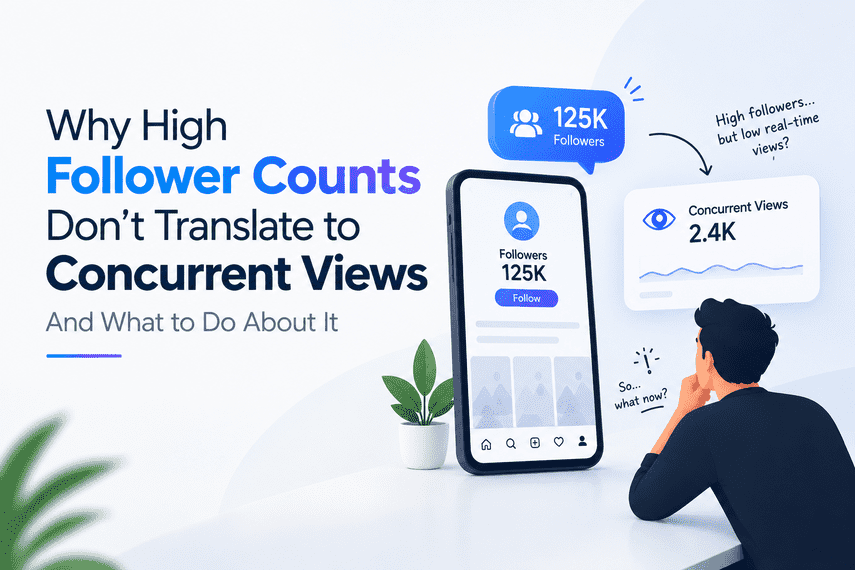

You hit a milestone. Maybe it was 1,000 followers. Maybe 5,000. Maybe even 10,000. You celebrated, you felt the momentum, and you went live expecting to finally see real numbers in that viewer counter.
And then… three people showed up. Maybe five on a good day.
If that scenario sounds painfully familiar, you are not alone and more importantly, you are not failing. The disconnect between high follower counts and low concurrent viewers is one of the most common and least-explained frustrations in the creator world. It trips up streamers, confuses influencers, and quietly burns out some genuinely talented people who assume the problem is them.
It isn’t. Let’s break down exactly why this happens and what you can actually do about it.
The Illusion of Scale: Why High Follower Counts Don’t Guarantee Concurrent Views
Understanding Concurrent Viewers vs. Cumulative Followers
These two numbers measure completely different things, and treating them as related is where most creators go wrong.
Your follower count is cumulative. It’s the total number of accounts that have ever clicked “Follow” on your profile since the day you started. It includes people who followed you two years ago after a clip went semi-viral, people who followed you during a raid and never came back, people who have since deleted their accounts, and people who simply moved on to different content. That number only ever goes up, and it never forgets anyone.
Concurrent viewers or CCV is the number of real people actively watching your stream at any given moment, right now. It’s a live snapshot of your actual engaged audience, not a historical archive of every interaction you’ve ever had.
The relationship between these two numbers is almost never what creators expect it to be. Industry data consistently shows that even healthy, well-managed channels see a CCV-to-follower ratio of roughly 1–3%. That means a channel with 10,000 followers might realistically expect 100–300 concurrent viewers on a strong stream and significantly fewer if those followers were accumulated passively over time or include a high proportion of disengaged accounts.
That math is hard to sit with. But understanding it is the first step toward building something that actually lasts.
Vanity Metrics vs. Actionable Audience: A Critical Distinction
A vanity metric is a number that feels meaningful but doesn’t directly predict your success. Follower count is the ultimate vanity metric in live streaming.
It looks great on a profile page. It helps with brand deal negotiations. It signals a level of reach to people who don’t understand the nuance. But it tells you almost nothing about how many people will actually show up when you go live tonight.
An actionable metric, by contrast, is something that reflects real behavior and real engagement. Concurrent viewers, chat velocity, average watch time, and follower-to-viewer conversion rate these are the numbers that tell you whether your content is actually working and whether your community is genuinely invested.
The sooner you shift your attention from follower counts to actionable metrics, the sooner you’ll start making decisions that actually improve your streams.
The Algorithmic Reality: Why Your Followers Aren’t Showing Up
The Shift from Follower-Based Feeds to Interest-Based Discovery
Twitch, TikTok, Instagram, and YouTube all underwent a fundamental shift over the past few years. Platforms moved away from chronological or follower-based content delivery and toward interest-based algorithmic feeds. What this means in practice is that following someone no longer guarantees you’ll see their content.
On YouTube, a subscriber might get a notification for one out of every five of your uploads, depending on their notification settings and the algorithm’s assessment of their engagement likelihood. On Twitch, a follower notification for a stream going live competes with hundreds of other notifications across every platform that person uses and the notification might not even fire at all depending on their settings.
The implicit promise of “follow me and you’ll always know when I’m live” is a promise the platforms no longer keep. Followers opted into a relationship, but the platforms are the gatekeepers of whether that relationship ever gets triggered.
Notification Fatigue and Platform Delivery Throttling
Let’s compound the problem. Most people follow far more creators than they actively watch. Over time, the habit of following someone is divorced from the habit of actually watching them. A viewer might have clicked follow during an exciting stream, had genuine intentions of coming back, and then simply… never did not because they dislike you, but because life moved on and the follow notification got buried in a pile of other alerts.
Platform delivery throttling makes this worse. Twitch, for example, does not guarantee that every follower receives a live notification. The system prioritizes delivery to followers who have shown recent engagement with a specific channel. If someone followed you six months ago and hasn’t interacted with your content since, there’s a meaningful chance they simply don’t get notified when you go live. The platform treats their notification slot as low-value and deprioritizes it.
This isn’t a bug. It’s a design choice and it systematically disadvantages channels with older, less-engaged follower bases.
Ghost Followers, Bot Accounts, and Natural Audience Attrition
Not everyone who ever followed you is still an active TikTok, Twitch, or YouTube user. People quit platforms. Accounts get banned. Bots get purged. Life changes. The human being who followed you 18 months ago might have stopped using the platform entirely.
Natural audience attrition is real and it’s universal. Industry estimates suggest that anywhere from 20–40% of a creator’s follower count on any given platform is composed of inactive or effectively non-existent accounts at any point in time. That percentage climbs higher for channels that experienced rapid growth from a viral moment because viral follows tend to be low-intent, and low-intent follows drift into inactivity faster.
None of this shows up in your follower counter. That number just sits there looking encouraging while quietly including all the people who are never, ever coming back.
The Psychological Toll: Creator Demotivation and Imposter Syndrome
The Comparison Trap: Why Follower Count Causes Unrealistic CCV Expectations
Here’s where it gets personal, because this isn’t just a data problem. It’s a deeply human one.
When your follower count is high but your viewer count is low, the natural instinct is to look outward and compare. You see another creator with a similar follower count streaming to three times your viewers, and the thought creeps in: What are they doing that I’m not? Is my content actually bad? Am I missing something obvious that everyone else has figured out?
This comparison is almost always unfair to yourself, because you’re usually comparing your CCV to someone else’s follower count or vice versa without knowing the full picture. You don’t know what percentage of their followers are active. You don’t know how they built their audience, whether it was through raids, viral clips, or years of slow compounding growth. You don’t know their stream schedule or how aggressively they prime their community off-platform.
The comparison trap pulls you toward chasing the wrong number. When the number you’re chasing doesn’t deliver the results you expected, it doesn’t just sting it shakes your sense of whether you belong in this space at all.
That’s the beginning of imposter syndrome for creators, and it’s far more common than anyone talks about publicly.
Overcoming Burnout When the Numbers Don’t Match Your Effort
There is a particular kind of exhaustion that comes from working hard and seeing flat numbers. It’s different from general burnout. It has a specific texture a sense that the effort isn’t connecting, that the output isn’t landing, that you’re shouting into a room and no one is turning around.
Research in the creator economy consistently flags this gap between follower count and live viewership as one of the primary drivers of creator burnout. According to various creator economy studies, a significant majority of streamers and content creators report considering quitting within the first two years, with “lack of growth” and “poor engagement relative to effort” cited as the leading reasons.
The tragedy is that many of those creators weren’t actually failing at content. They were failing at understanding the gap between follower accumulation and community cultivation and those are genuinely different skill sets.
Understanding that the numbers are structurally misleading doesn’t magically fix the emotional weight of seeing a viewer counter sit at four. But it does give you somewhere more rational to put the frustration, and it opens the door to making changes that actually address the real problem instead of spiraling into self-doubt.
Redefining Success: Metrics That Actually Matter for Creators
Engagement Rate, Chat Velocity, and Average Watch Time
If you want a clearer picture of how your content is actually performing, start measuring things that reflect real behavior.
Engagement rate — the ratio of interactions (comments, shares, reactions) to your total reach tells you far more about content resonance than a follower count. A creator with 3,000 followers and a 12% engagement rate has a more genuinely connected audience than one with 30,000 followers and a 0.4% engagement rate.
Chat velocity — the rate at which messages appear in your Twitch chat during a stream is one of the most honest indicators of audience health in live streaming. An active chat with ten people creates more energy than a dead chat with fifty passive viewers. Advertisers and brand managers in the know look at chat activity alongside CCV because they understand that chat tells you something raw viewer counts don’t.
Average watch time is your content’s most honest feedback mechanism. If viewers are staying for 45 minutes of a two-hour stream, that’s a conversation worth having with yourself about pacing. If they’re staying for the full two hours, that’s a signal the content is genuinely compelling. Follower count tells you nothing about watch time. Watch time tells you everything about audience investment.
Core Community Density: The 1,000 True Fans Model
The concept of “1,000 True Fans” popularized by writer Kevin Kelly argues that a creator needs just 1,000 genuinely devoted fans to build a sustainable creative career. Not 1,000 casual followers. Not 1,000 people who clicked a button once. One thousand people who actively engage, come back reliably, share your content, and support your work.
That number is far smaller than most creators are aiming for, and it reframes everything.
A Twitch streamer with 500 followers but 80 people who show up to every single stream is richer in community terms than a creator with 50,000 followers and 30 unreliable viewers. The 500-follower streamer has a core community. The 50,000-follower streamer has a number.
Core community density is the metric that actually predicts long-term creator success. Building 100 truly loyal viewers who bring their friends, subscribe, gift subscriptions, and show up consistently is a better investment of your energy than chasing the next follower milestone.
Strategic Playbook: How to Bridge the Gap Between Followers and Live Viewers
Pre-Stream Priming and Off-Platform Community Anchoring
The biggest mistake most streamers make is treating their stream start as the beginning of the process. By the time you go live, the work that determines who shows up has already been done — or not done.
Pre-stream priming means communicating with your community before you’re live. A post in your Discord server a few hours before you stream. A story or short video on Instagram or TikTok reminding people what you’re playing and why tonight’s stream is worth showing up for. An email to your newsletter list if you have one.
Discord and email newsletters are the two most reliable off-platform anchors a creator can build, precisely because they’re not subject to algorithmic throttling. If someone is in your Discord server, they see your message. If someone subscribed to your newsletter, they receive your email. These are direct lines to your community that no platform can cut off.
Building these channels takes time, but the return is enormous. A community of 200 people in an active Discord server will deliver more reliable CCV than 10,000 followers who only know you through a platform notification that might or might not fire.
Optimizing Stream Scheduling, Packaging, and Hook Delivery
Consistency in scheduling is one of the most underrated drivers of live viewership. Viewers who know you stream every Tuesday and Friday at 7pm will block that time. Viewers who never know when you’re going live can’t plan around you, even if they want to.
Pick a schedule that’s sustainable for you three or four streams a week is significantly better than seven streams a week for one month followed by a burnout break and stick to it with the same reliability you’d give a job shift.
Your stream title and thumbnail (or cover image) also function as packaging. They’re the split-second pitch that tells someone who’s already following you whether tonight’s stream is worth opening. “Playing Minecraft” is not a hook. “Building the most dangerous trap base on the server come watch it go wrong” is a hook. The difference in click-through rate between those two titles can be the difference between twelve viewers and sixty.
Conclusion: Shifting Your Mindset from Follower Accumulation to Community Cultivation
Here’s the honest truth that nobody frames this way at the beginning of a creator’s journey: the number on your profile page is a historical artifact. The number in your viewer counter is a living, breathing reflection of the community you’ve actually built.
Chasing followers is not a growth strategy. Building a community is.
That means investing in the relationships you have, not just the ones you’re trying to acquire. It means showing up for the twelve people in chat with the same energy you’d give to twelve hundred. It means building off-platform homes for your community so that your reach doesn’t depend entirely on whether an algorithm decides to deliver a notification.
And it means measuring your success by the things that actually reflect your progress engagement, watch time, chat activity, community loyalty rather than a follower counter that will always look more impressive than it actually is.
The creators who figure this out early stop grinding against a misleading metric and start building something real. They’re the ones still streaming two years from now, not because the numbers finally got big enough, but because the community got strong enough.
If you’re ready to grow that community with strategic, targeted reach, the team at NexTech Ads specializes in helping streamers and creators cut through the noise and build audiences that actually show up. Visit nextechads.com to learn how.
FAQ: Follower Count vs. Concurrent Viewers
Why do I have lots of followers but barely any viewers?
Because followers accumulate over time and include inactive, disengaged, and platform-quit accounts. Concurrent viewers reflect only the people who are actively watching right now. The two numbers measure fundamentally different things and should never be expected to scale proportionally.
What is a good follower-to-viewer ratio on Twitch?
A ratio of 1–3% is considered healthy for most channels. A channel with 5,000 followers averaging 50–150 concurrent viewers is performing within a normal range. Higher ratios indicate a particularly engaged or well-primed community.
How do I get more of my followers to actually watch my streams?
Build off-platform community anchors Discord, newsletters, social media and prime your audience before going live. Consistent scheduling also dramatically improves viewer attendance because followers can plan around a predictable time.
Does notification delivery affect how many followers see my streams?
Yes. Platforms throttle notification delivery based on follower engagement history. Followers who haven’t interacted with your channel recently may not receive live notifications at all, regardless of their settings.
What metrics should I track instead of follower count?
Average concurrent viewers, chat velocity, average watch time, follower-to-viewer conversion rate, and engagement rate. These reflect actual audience behavior rather than accumulated historical data.
Is burnout over low viewer numbers normal for creators?
Extremely common. The gap between follower count expectations and live viewership reality is one of the most frequently cited contributors to creator burnout. Understanding that this gap is structural not a personal failure is the first step toward a more sustainable relationship with the numbers.