

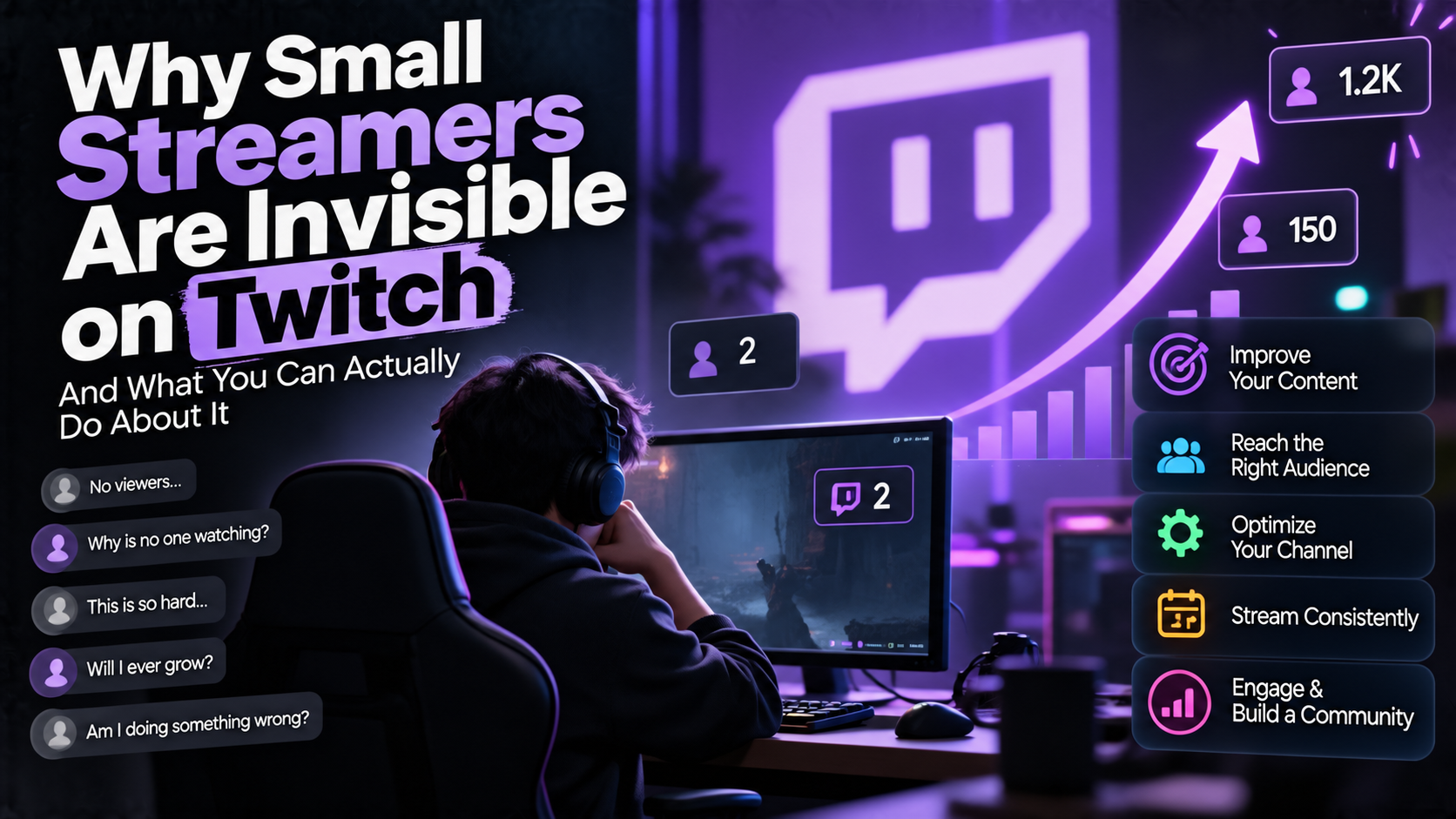

Let’s be honest about something most streaming guides dance around: if you’re a small streamer on Twitch, you’re not just competing for viewers. You’re competing against a platform structure that was never really designed to help you get found in the first place.
That’s not a reflection of your content. It’s not about your personality, your production quality, or how many hours you’re putting in. The reason you feel invisible on Twitch is structural and once you understand the mechanics behind it, you can stop blaming yourself and start making smarter decisions.
The Directory Problem: How Twitch’s Sorting Works Against You
Here’s the core issue, stated plainly: Twitch sorts channels in its category browser by current viewer count, from highest to lowest. That’s it. That’s the whole system.
When someone opens a game category on Twitch, they see the channels with the most concurrent viewers at the top. The channels with zero or low viewers sink to the bottom sometimes page fifteen, sometimes page forty, depending on the category. And almost nobody scrolls that far. Research consistently shows that the average Twitch viewer browsing a category never scrolls past position 30.
What this creates is a feedback loop that only rewards momentum. Channels with big audiences stay visible because they have big audiences. Small channels stay invisible because they don’t. And the directory doesn’t care about your content quality, your personality, your mic setup, or how many hours you’ve been streaming. It counts heads, and it counts them in real time.
A new streamer broadcasting in 4K with studio-grade sound sits in exactly the same position at the bottom of the directory as someone streaming from a laptop with average audio. The sorting algorithm has no opinion about production value. It only counts viewers.
That’s the wall every small streamer runs into, and it’s why the grind can feel so demoralizing early on.
The Cold Start Is Structural, Not Personal
This is the thing that nobody tells new streamers before they go live for the first time. The reason your first streams get zero organic viewers from Twitch isn’t because you did anything wrong. It’s because you started from zero, and the directory rewards existing numbers not potential.
People talk about “the Twitch algorithm” as if it works like YouTube’s or TikTok’s a system that studies your content and pushes it to the right people. It doesn’t work that way. Twitch’s discovery is mostly a directory that sorts live channels by viewer count, and that single design choice explains almost everything about how channels grow or stall here.
A genuinely better stream sitting at two viewers will lose browse placement to a mediocre one at fifty, because the directory only sees the number, not the quality behind it.
The painful irony is that you need viewers to get viewers. You need engagement to get recommended. You need existing momentum to gain more momentum. Starting from zero means you enter the system at the exact point where the system gives you nothing back. That’s not a personal failing it’s a structural reality that every small streamer faces.
With over 7 million active streamers broadcasting on Twitch and approximately 75% of them streaming to fewer than 5 viewers at any given time, you’re in a huge crowd. The platform just isn’t designed to surface most of that crowd to new viewers.
Category Choice Is the Lever You Actually Control
If the directory is the problem, your category selection is one of the few things you can genuinely influence to improve your position within it.
Not every game category is equally hostile to small channels. The top ten categories on Twitch absorb roughly 47% of everything watched on the platform. Streaming Fortnite or League of Legends as a new creator means you’re competing with thousands of other channels, most of which have established audiences that lock up the top positions indefinitely.
Mid-sized categories games with enough viewers to be worth streaming, but few enough channels that you can actually appear on the first few pages of the directory give a small channel a realistic chance of being seen. Check the category before you go live: look at how many concurrent viewers the channel in the 15th–20th position has. If that number is 200, you need 200 viewers to even be visible in that category. If it’s 20, you have a realistic path.
This doesn’t mean abandoning games you love. It means being strategic about when and how you stream them. You might stream a popular game during off-peak hours when fewer channels are competing, or pair it with a smaller niche tag that filters your audience into a more reachable pool.
Smaller doesn’t mean bad. It means accessible. And for a streamer just starting out, accessible is everything.
Tags and Category Alignment: The Other Side of the Equation
Tags on Twitch don’t create discovery on their own five perfect tags on an invisible stream still equal an invisible stream. But they do serve a purpose worth understanding.
Tags help viewers filter results after they reach your directory page or encounter your stream through recommendations. They’re a relevance signal, not a promotion tool. Aligning your tags tightly with your actual content and category means that the viewers who do find you are far more likely to stick around, which is critical for building the engagement signals that help you grow.
In 2026, Twitch overhauled its internal SEO and tagging system, which means tags now carry more weight for recommendation surfaces like the Discovery Feed than they did in previous years. Getting your tags right language, content type, tone, niche matters more now than it did before.
Think of category and tag alignment as making sure that when someone does land on your channel, everything they see confirms they’re in the right place. Consistency here builds stronger retention, and stronger retention is exactly what the algorithm uses as a signal to push your content further.
Being Live Is a Precondition, Not a Strategy
This is one of the hardest mental shifts for new streamers. Consistency matters enormously but being live by itself isn’t a growth strategy anymore, if it ever was.
If you stream consistently for two years in a saturated category, you will be consistently invisible. Logging more hours in a category where you’re buried on page twenty doesn’t change the math. More hours of streaming in the wrong conditions just means more hours of no one seeing you.
Being live is the foundation. You have to show up to build community, to create the raw material for clips, to develop your on-camera presence. But going live and waiting for Twitch to bring people to you in 2026 is not a complete strategy. The viewers aren’t coming from the directory. You have to go get them from somewhere else.
That’s the mindset shift that separates growing channels from stuck ones.
Clips and VODs Are the Real Discovery Layer
Here’s where the conversation gets genuinely exciting, because this is where the opportunity actually lives for small streamers in 2026.
The streamers who are growing fastest on Twitch right now are treating their streams as content factories not as the main event, but as the raw material for short-form clips that do the actual discovery work elsewhere. In 2026, discovery happens on TikTok, YouTube Shorts, and Instagram Reels in short clips and 30-second moments that end up in someone’s For You feed. Twitch is where people go to watch streamers they already know.
Streamers who post 5–10 TikTok or YouTube Shorts clips per week from their VODs grow 3–5x faster than those who only stream. That’s not a small difference it’s the difference between being stuck and building real momentum.
The workflow is simple, even if it takes discipline to maintain: stream, identify the two to five best moments, cut them into vertical clips with captions, and post them consistently across short-form platforms. Each clip functions as a standalone piece of entertainment that also acts as a trailer for your live channel. Some of those clips will still be pulling views from search and recommendations months after you posted them. The compounding effect is the whole point.
Your VODs are a goldmine. Most streamers leave that goldmine completely untouched.
Twitch’s own Discovery Feed on mobile now surfaces short vertical highlights directly on the platform, which means clips done right work both on Twitch and on the platforms where you can build a broader audience. If your clips aren’t vertical, you’re mostly invisible on mobile and mobile is where most casual discovery happens.
External Traffic: The Growth Path Nobody Warns You About
The most successful small streamers in 2026 don’t grow through Twitch. They grow to Twitch from somewhere else.
Building an audience on short-form video even a modest one and then converting that audience into Twitch followers and viewers is the fastest path from zero to affiliate and beyond. Every clip you post with a clear call-to-action pointing back to your Twitch channel is a potential on-ramp for a new regular viewer.
Discord communities, Reddit threads in relevant gaming or streaming spaces, and genuine participation in other streamers’ chats all create pathways that the directory never will. Growth through Twitch’s internal discovery alone typically requires sustained networking, raids, and viewer engagement over 12–18 months. That timeline shrinks significantly when you add external traffic sources.
This is also where a dedicated Twitch promotion service can make a genuine difference. Getting your channel or content in front of the right audience people who are actually interested in the kind of content you make accelerates the entire growth cycle. The early days of any Twitch channel are about reaching the visibility threshold where Twitch starts working with you instead of against you. Having professional promotional support behind you can get you there faster.
At NexTech Ads, we help streamers and creators build the kind of targeted reach that changes the math on discoverability. Whether you’re just starting out or trying to break through a plateau, the right growth strategy makes everything you’re doing on stream count for more. Visit nextechads.com to see how we work with creators at every stage.
The Follower-to-Viewer Ratio: Reading Your Own Data
One metric that small streamers often overlook is the relationship between their follower count and their average concurrent viewers. This ratio tells you a lot about the health of your channel community.
A new channel with 500 followers averaging 2–3 viewers has a follower-to-viewer ratio of roughly 0.5%. That’s actually common for accounts in early growth many followers aren’t active at any given moment. But as your channel matures, you want to see this ratio improve, not just your raw follower count.
Channels with a high follower count and a very low viewer ratio often have an engaged notification problem followers added at a point in time who no longer tune in. Focusing on building a smaller, genuinely active community that shows up consistently beats chasing raw follower numbers every time. Twitch’s recommendation signals care about engagement and watch time, not just accumulated followers.
FAQ: Small Streamers on Twitch
Why does Twitch seem to favor big streamers?
Because the directory sorts channels by concurrent viewers, channels with existing audiences automatically appear at the top of category listings. It’s not an intentional bias against small creators it’s a consequence of a sorting system that rewards momentum. The bigger you already are, the more visible you are, which brings in more viewers, which keeps you visible.
Does Twitch have an algorithm like YouTube or TikTok?
Not in the same way. Twitch’s primary discovery engine is its category browser sorted by viewer count. There is a Discovery Feed on mobile that surfaces clips and can push small creators, but it’s not the dominant discovery mechanism the way YouTube’s recommendation engine is. External traffic from clips and social media remains far more reliable for small channel growth.
What category should a small streamer choose?
Look for categories with enough viewers to be worth streaming, but few enough competing channels that you can appear in the first few pages of the directory. Check the viewer count of the 15th–20th channel in any category before you go live that’s approximately the threshold you need to be visible at the front of the list.
Do tags help small streamers get discovered?
Tags help viewers who find you understand what your stream is about, which improves retention. They’re also increasingly used in recommendation signals since Twitch’s 2026 tag system overhaul. But tags alone won’t bring viewers to an otherwise invisible stream category positioning and external traffic are the more powerful levers.
How many clips should I make per stream?
Two to five clips per stream is a solid starting goal. Posting one clip after every stream consistently beats posting ten clips once and then going silent for weeks. Consistency compounds over time clips from months ago can still be pulling in new followers from search and recommendations.
How long does it realistically take to grow on Twitch?
It depends heavily on whether you’re also posting clips off-platform. Streamers using external short-form channels alongside consistent streaming can hit Twitch Affiliate in 30–60 days. Relying solely on Twitch’s internal discovery typically adds 12–18 months to that timeline, assuming you’re networking actively. The gap between those two paths is the strongest argument for building an off-platform strategy from day one.
Is Twitch still worth it for new streamers in 2026?
Yes but with realistic expectations. Twitch is still the dominant live streaming platform with 70 million monthly active users. The community infrastructure, subscription model, and clip ecosystem are all genuinely valuable. The key is going in knowing that Twitch is a community platform, not a discovery engine. You build the audience somewhere else, then bring them to Twitch.
The Bottom Line
The feeling of invisibility on Twitch is real, and it’s earned because the system genuinely does work against small channels in the early stages. That’s not a reason to quit. It’s a reason to stop expecting Twitch to do the discovery work for you.
Choose your categories strategically. Make clips after every stream. Build an off-platform presence on short-form video. Show up consistently and give each stream a reason to exist beyond just logging hours. And when you’re ready to accelerate the process, working with a team that understands creator growth like NexTech Ads can be the difference between grinding in obscurity and actually breaking through.
The path exists. It just doesn’t go through the directory.