


Here’s a feeling most creators know well. You open YouTube Studio, see a click-through rate you’re proud of, and think, “This one is going to fly.” Then the impressions barely move. Or they start strong and quietly fade out.
It’s confusing, and honestly a bit heartbreaking when you’ve put real effort into a video.
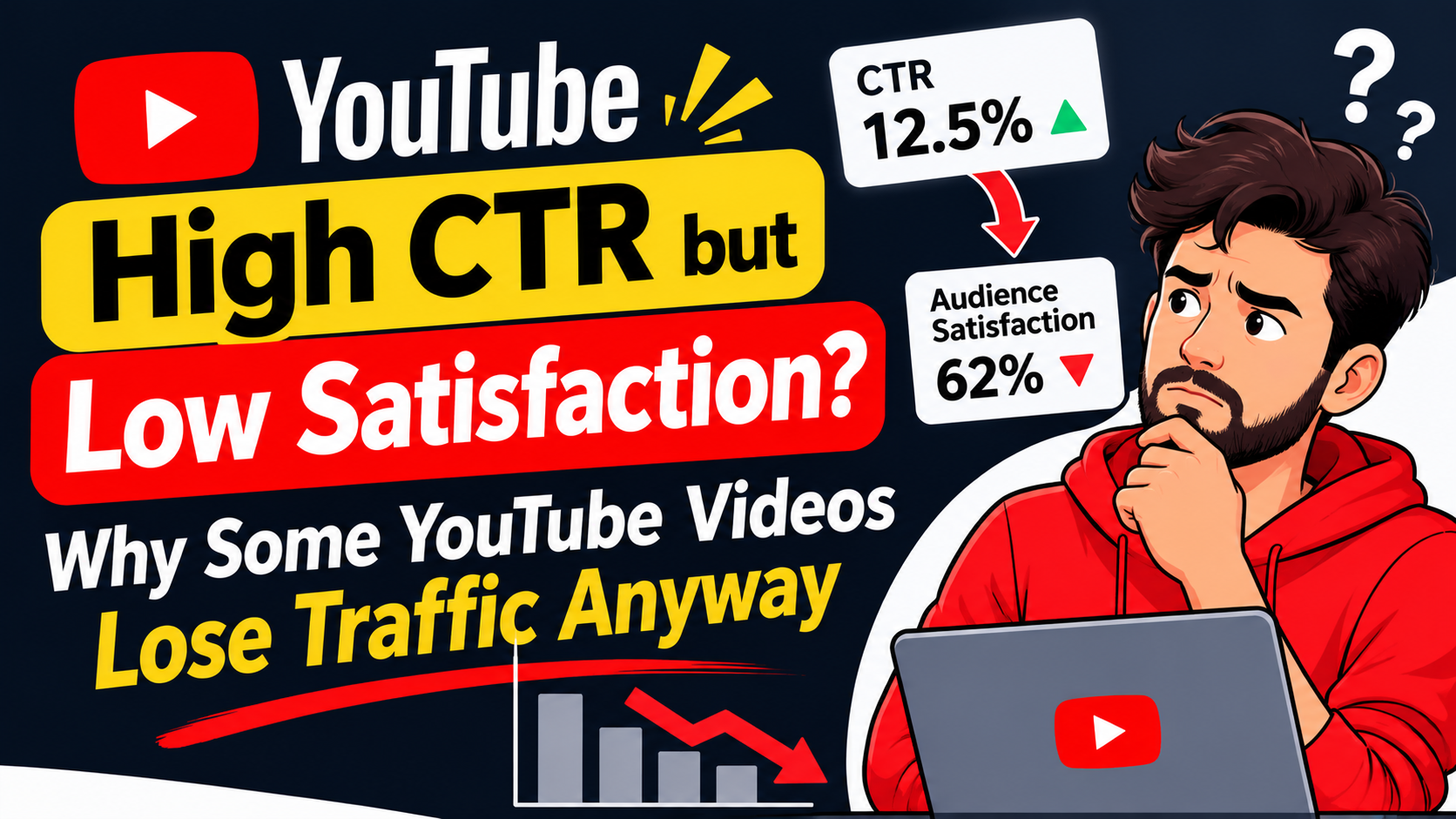
The truth is that CTR is only one piece of the puzzle. A video can win the click and still lose the viewer’s approval a minute later. In this guide, we’ll look at why high CTR and low impressions happen together, what satisfaction has to do with it, and how to troubleshoot without panicking.
Overview: Clicks Are Not the Same as Satisfaction
You’ll often hear that videos with great CTR and retention but poor viewer satisfaction get “severely throttled.” I want to be careful here, because that’s stronger than anything YouTube has actually published.
What YouTube does say is simpler. Its recommendation system learns from over 80 billion signals, and it uses satisfaction surveys to understand how people felt about a video, not just how long they watched. Surveys sit alongside likes, dislikes, “Not interested” feedback, watch history, and more.
So there is no public rule saying one bad survey score cuts your traffic. But the direction is clear. If people click, watch, and still feel unsatisfied, YouTube has less reason to keep pushing that video to new viewers. Think of satisfaction as one of the signals that decides how far a video travels, not a switch that turns it off.
The good news is that you can influence it. Let’s walk through how.
What Does YouTube CTR Actually Measure?
CTR stands for click-through rate. In plain words, it’s the share of people who clicked your video after your thumbnail appeared in front of them.
If your thumbnail was shown 1,000 times and 80 people clicked, your CTR is about 8%.
The key detail is that CTR only counts people who actually saw an impression. It says nothing about how many people could have seen your video, and nothing about what they thought afterward. It measures the click, not the experience.
How Can CTR Be High While Impressions Stay Low?
This is the question behind most of these worried emails. A high CTR tells you that the people who saw your video found it appealing. It doesn’t tell you that YouTube has decided to show it to a much bigger crowd.
Picture a video shown 100 times with 12 clicks. That’s a 12% CTR, which looks fantastic. But YouTube has very little data on that video yet, and the audience it has reached is tiny.
Now compare it to a video shown 50,000 times with 2,000 clicks. The CTR is only 4%, but it earns far more total views.
Neither percentage is “better” on its own. What matters is the combination of how many people see the video, how many click, and how they feel once they’re inside.
Can a Small Number of Impressions Make CTR Look Better?
Yes, and this trips up even experienced creators.
With a small sample, a single click can swing the percentage a lot. Twenty impressions and four clicks gives you 20% CTR, which sounds amazing but means very little. One extra click, one fewer click, and the number jumps around.
As impressions grow, the number settles and becomes more trustworthy. So if a brand-new video shows a spectacular CTR after a few dozen impressions, enjoy it, but don’t build a strategy on it. Give it time to collect real data before drawing conclusions.
Does CTR Change by YouTube Traffic Source?
It does, and this is where many diagnoses go wrong.
Someone typing a specific question into YouTube search is already looking for an answer, so a relevant title can earn a very high click rate. Someone scrolling the homepage is casually browsing, so your thumbnail has to compete with many other options.
The same thumbnail can look brilliant in one place and average in another. Before you compare your CTR to another video, open the Reach tab in YouTube Studio and see where the impressions are actually coming from.
Are You Missing Browse Features Traffic?
Browse features, mainly the homepage and subscriptions feed, are often where videos get their biggest boost. YouTube’s own help page explains that the homepage is primarily personalized, built mostly from what each viewer has watched before.
A video can have a strong CTR from search viewers and still stay small if it isn’t getting homepage exposure. When you compare it with your past hits, check whether those earlier videos had a lot more Browse traffic. If so, the gap probably isn’t your thumbnail. It’s distribution.
Suggested traffic matters too. When someone is watching a video, YouTube uses that video as the main signal for deciding what to suggest next. If your video doesn’t clearly connect with what people are already watching, Suggested impressions can stay low.
Check Retention Before Blaming Reach
This is the step creators skip most often, and it’s the one that connects best to satisfaction.
A strong thumbnail and title make a promise. If the first minute of your video doesn’t deliver on that promise, people leave, and they leave unhappy. That’s a very different problem from “YouTube isn’t showing my video.”
Here’s a simple way to read the combinations:
- High CTR and strong retention usually means your packaging and content are both working, so look at audience size and traffic sources next.
- High CTR and weak retention means people click but leave quickly. Review your opening and whether you deliver on the title.
- Low CTR and strong retention means the video is good but the packaging isn’t pulling people in.
Open the audience retention graph and find where viewers drop off. If most people disappear in the first 20 to 30 seconds, the thumbnail and title may be promising something the opening doesn’t match. Fix the promise or fix the opening.
Why Satisfaction Is Harder to See Than CTR
You can see CTR and retention in your analytics. Survey results, though, aren’t shown to you directly. That’s what makes satisfaction feel mysterious.
You can still read the signs. Comments that say “That’s not what I expected” are a clue. So are low likes compared with views, and “Not interested” feedback you can’t see but may be causing. YouTube also says it considers a channel’s reputation and quality when deciding how, when, and to whom content gets surfaced.
In simple terms, the safest path is to make videos that leave people feeling glad they clicked. Honest packaging, a quick payoff, and content that matches the promise beat clever tricks every time.
Mistake One: Changing Everything at Once
When a video underperforms, the urge to fix everything is strong. New thumbnail, new title, new description, new tags, all in an hour.
The problem is that if the numbers move afterwards, you won’t know why. And you may have thrown away something that was actually working.
Change one thing at a time. If CTR is the weak point, test the thumbnail or the title. If retention is the weak point, look at the opening, not the packaging. This keeps your learning clean.
Mistake Two: Comparing Against Your Best-Ever Video
Every channel has an outlier. That one video that took off and set an impossible standard.
If you compare every new upload to it, almost everything will feel like a failure. Instead, compare each video with your recent typical uploads on a similar topic. That’s your real baseline. Beating your baseline steadily is how channels grow.
Also remember that topics have different ceilings. A broad topic may reach millions, while a specific tutorial may only ever reach a small group, and that’s perfectly fine. A smaller, happier audience is far better than a bigger one that clicks and leaves.
Use YouTube Studio’s Title and Thumbnail Testing Wisely
If your CTR really is the weak spot, YouTube Studio has a built-in way to test options. You can compare up to three titles, thumbnails, or combinations on a video, and YouTube shows the winner to everyone at the end.
Here’s the part that connects to this whole topic: the test is judged mainly on watch time, not clicks alone. That means a flashy thumbnail that disappoints viewers won’t automatically win. The tool quietly rewards honest packaging.
A few practical tips:
- Make your variations truly different from each other, so there’s something real to measure.
- Test older videos first if you want to protect your newer uploads.
- Leave the test alone once it starts, because changing the title or thumbnail mid-test stops it.
Don’t be discouraged by a “no clear winner” result. It often means your options were too similar or the video didn’t get enough impressions.
Why CTR Can Drop When Impressions Increase
This confuses a lot of creators, but it’s actually a good sign in many cases.
Early on, your video is mostly shown to subscribers and loyal viewers who already like you, so CTR is high. As YouTube tests it with a wider audience, those newer viewers are less familiar with you and click less often. CTR dips even though far more people are watching.
A video that goes from 500 impressions at 12% to 20,000 impressions at 5% has not gotten worse. It has grown. Don’t trade reach for a prettier percentage.
Where a Video Promotion Service Fits In
Sometimes a video is good, the packaging works, retention is solid, and it still stalls. Often it just hasn’t met enough of the right people yet.
That’s where a thoughtful video promotion service can help. Getting the video in front of viewers who genuinely care about the topic gives YouTube more real data to learn from, and gives you honest feedback on whether the content satisfies people.
Promotion works best when the video is already worth watching. It can bring in the first wave of viewers, but it can’t make an unsatisfying video satisfying. At NexTech Ads, we help creators, influencers, and streamers reach targeted audiences so strong videos don’t get lost. If you’d like support, visit nextechads.com to see how we work.
A Simple Checklist Before You Change Anything
When a video has good CTR but weak reach, run through these questions in order. How many impressions is the CTR based on? Where is the traffic coming from? Is the topic realistically large? How does retention look in the first minute? Does the opening deliver the title’s promise? Are comments hinting at disappointment? And how does this video compare with your recent average, not your best?
Most of the time, the answer shows up before you touch the thumbnail.
Frequently Asked Questions
Is a high CTR with low impressions a bad sign?
Not necessarily. It usually means the small audience seeing the video likes it, but YouTube hasn’t expanded distribution yet. Check sample size, traffic sources, and retention.
Do low satisfaction survey scores really throttle traffic?
YouTube doesn’t publish a rule like that. It does confirm that satisfaction surveys are one of several signals it uses, so unhappy viewers are unlikely to help your reach.
Can I see my satisfaction survey results?
No, not directly. You can watch indirect signs such as comments, likes compared with views, and how retention behaves after the opening.
Should I change my thumbnail if CTR is already high?
Usually not. First find out whether reach is limited by traffic source, topic size, or retention.
Why did my CTR fall as my video grew?
Broader distribution reaches viewers who know you less, so the percentage often dips while total views rise.
Does a high CTR guarantee more impressions?
No. YouTube weighs many signals and personalizes recommendations for each viewer, so no single CTR number guarantees wider reach.
Is low reach the same as a shadowban?
No. Low impressions alone don’t prove a hidden restriction. Review your normal analytics and any visible notices in YouTube Studio first.
Can promotion help a video with limited reach?
It can add early viewers and useful data, but it works best on videos that already deliver on their promise.
Final Thoughts
A high CTR is a lovely thing to see, but it’s only the start of the story. What happens after the click, how the viewer feels, and whether they’d happily watch another of your videos, matters just as much.
So next time a video gets clicks but stalls, stay calm. Look at the sample size, check your traffic sources, read your retention graph, and ask yourself honestly whether the video kept its promise. Change one thing at a time and compare against your own baseline.
Make people glad they clicked, and the reach tends to follow.